





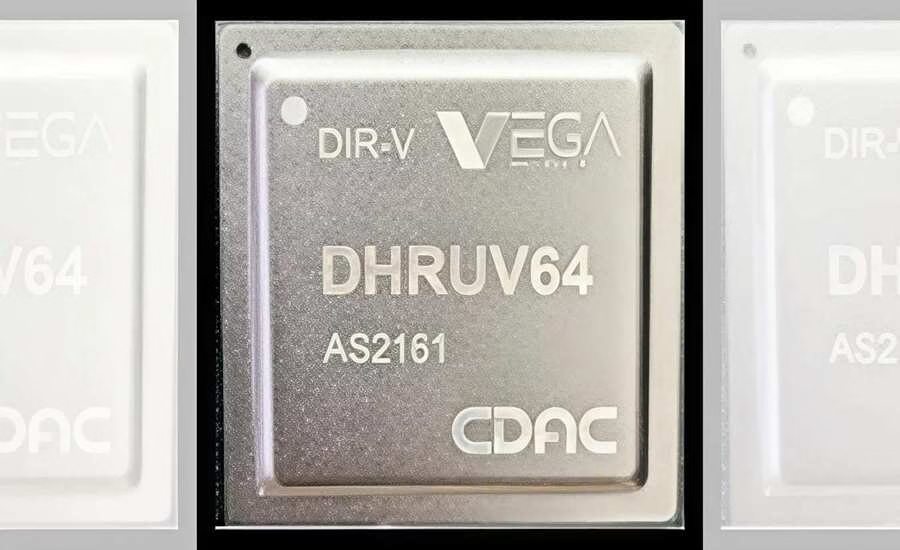
India has taken an important step in its technology journey with the launch of Dhruv64, the country’s first fully homegrown microprocessor. The chip was officially unveiled on Monday and has been developed by the Centre for Development of Advanced Computing (C-DAC) under the Microprocessor Development Programme (MDP).
Dhruv64 is part of the Digital India RISC-V (DIR-V) initiative, which focuses on building Indian capabilities in chip design, testing, and prototyping using open source technology. The goal is clear: reduce India’s dependence on imported chips and strengthen local electronics manufacturing.
What is Dhruv64 and why it matters
A microprocessor acts as the brain of electronic devices, handling instructions and enabling software and hardware to work together. Dhruv64 is a 1.0 GHz, 64-bit dual-core processor built on the RISC-V architecture.
RISC-V is an open and royalty free chip design standard. Unlike traditional chip architectures that require expensive licenses, RISC-V allows researchers, startups, and companies to design and improve processors without high costs. This makes innovation faster and more affordable.
Because of its specifications, Dhruv64 can be used across a wide range of applications. These include 5G networks, automotive systems, industrial automation, and Internet of Things (IoT) devices.
Strategic importance for India
India currently uses nearly 20 percent of the world’s microprocessors, but produces very few of them domestically. Dhruv64 is aimed at changing this situation by creating a strong local ecosystem where new products can be designed and scaled within the country.
Using an indigenous chip is also important from a security point of view, especially for defense and critical infrastructure, where relying on foreign hardware can pose risks.
What comes next
Dhruv64 is not a standalone effort. It builds on earlier India designed processors such as Thejas32 and Thejas64. In the future, more advanced processors named Dhanush and Dhanush+ are already under development.
Government support behind the chip push
Several government programs are working together to support India’s semiconductor ambitions. Along with DIR-V, initiatives like the India Semiconductor Mission (ISM), Chips to Startup (C2S), Design Linked Incentive (DLI) scheme, and INUP-i2i are helping boost chip design, manufacturing, and innovation.
Together, these efforts aim to strengthen India’s position in the global semiconductor industry and build a self-reliant technology ecosystem.