





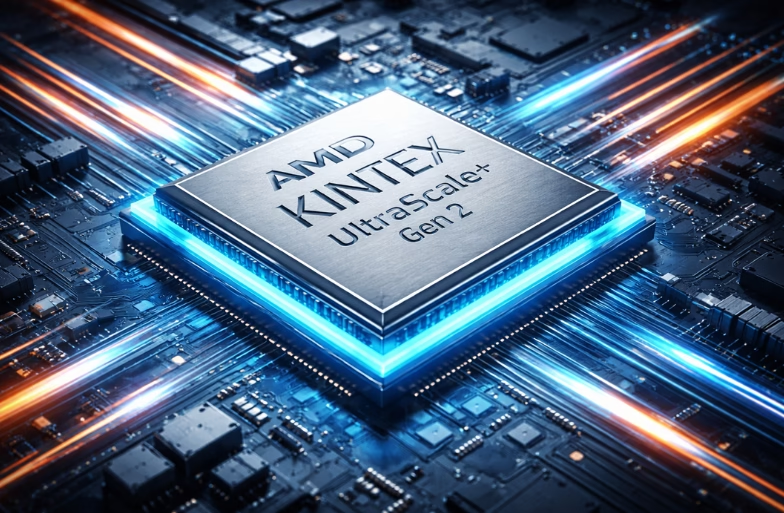
Advanced Micro Devices (AMD) has introduced a new family of mid-range FPGA chips called the “Kintex UltraScale+ Gen 2” at a technology event. These chips aim to help designers build fast and reliable systems for video, industrial and scientific use. Their key upgrades include much faster memory support, modern connectivity and stronger security.
What’s New In The Kintex UltraScale+ Gen 2 Series
AMD’s Kintex UltraScale+ Gen 2 FPGAs are a 2nd generation update to its mid-range devices. They build on a long-standing FPGA lineup that many embedded designers already use. The new family focuses on modern memory, faster interfaces and security features that were not available on prior models.
The Gen 2 chips support LPDDR4X, LPDDR5 and LPDDR5X memory using built-in controllers. This change gives designers much higher memory bandwidth. The new parts can deliver up to 5 times more memory throughput than the older generation.
These FPGAs also include PCIe® Gen4 support and many high-speed interfaces such as 100 Gigabit Ethernet, MIPI and HDMI. The design improves data movement and connection with other systems.
Faster Memory And Better Performance All Around
Memory speed and data handling are central to the Gen 2 improvements. The new chips add multiple LPDDR memory controllers built into the silicon. This helps systems process large data streams with low delay. For example, in applications like broadcast video or machine vision, equipment must move high-definition video frames quickly and without mistakes. The increased memory bandwidth supports these tasks and reduces any restrictions.
The support for PCIe Gen4 and high-speed transceivers also lets systems send data to servers or other chips without slowing down. This is vital for tasks such as 4K or 8K media workflows.
In simple terms, these chips are faster and more efficient at handling big and complex workloads. Designers can build systems that react and compute quickly at the point where the data is generated.
Stronger Security For Future-Ready Systems
Security is a priority in many embedded and industrial designs. AMD added advanced protection features to the new FPGAs. These include bitstream encryption and secure key management that help prevent unauthorised access.
Moreover, the devices also support CNSA 2.0-grade cryptography, which meets strict security standards for government and defence systems. Encryption and anti-cloning protections are built into the hardware. This makes it harder for attackers to copy or tamper with designs.
These enhancements are important for products that remain in use for many years and are exposed to networks or critical operations.
Where These New FPGAs Will Make The Biggest Impact
The Kintex UltraScale+ Gen 2 chips are not aimed at consumer devices. They are designed for high-performance and long-life systems in industrial, medical, broadcast and test equipment. In broadcast and video production, these FPGAs can handle multi-stream capture and delivery. The fast memory and interfaces help systems transmit high-resolution video with low latency.
They are also suited for test and measurement systems, where large volumes of data are analysed at high speed. This includes semiconductor testing and scientific instruments.
AMD has promoted the Gen 2 family as available through at least 2045. This long availability helps manufacturers support their products for many years without redesign.
When Can We Expect These Chips To Arrive?
AMD outlined a staged rollout for the new FPGAs. Simulation support for design tools like Vivado and Vitis will arrive in the 3rd quarter of 2026.
Early pre-production silicon samples are expected to be available in the 4th quarter of 2026. These allow engineers to test and validate their hardware designs. On the other hand, full production units are anticipated in the 1st half of 2027. That is when system builders can start shipping products that use the new chips.
AMD also offers migration paths from earlier devices. This helps designers begin work now and transition to Gen 2 when ready.
Why This Upgrade Matters For AMD And Its Users
This new FPGA family shows AMD’s continued investment in mid-range programmable chips. These parts fill an important gap between low-end and high-end devices. For many engineers, moving to a higher category of chip is costly and complex. These new chips aim to deliver better performance without a steep jump in price.
The key improvements in memory, interfaces and security help equipment keep pace with rising data rates and system demands. This matters in areas such as broadcast, robotics and advanced imaging. Strong long-term support also gives companies confidence that their products can remain on the market for decades.
In short, the Kintex UltraScale+ Gen 2 FPGAs offer a modern platform for future-ready systems that need speed, reliability and security in demanding environments.