




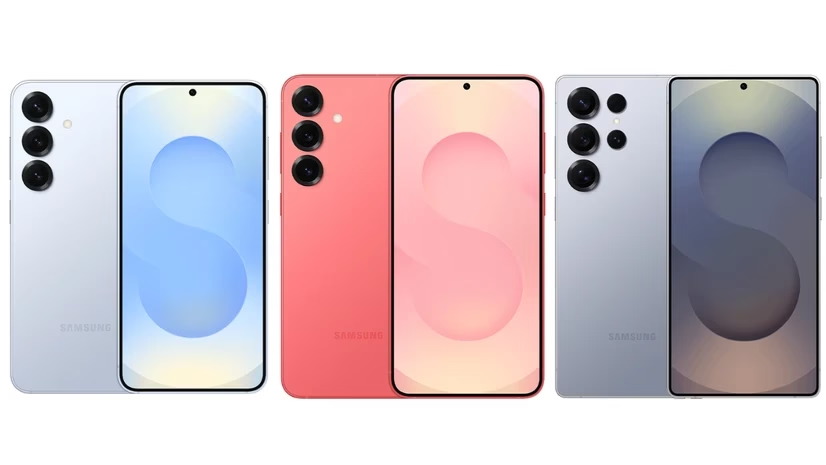
A new regulatory filing has surfaced for the unreleased Samsung Galaxy S26+, seemingly confirming the device’s existence despite earlier rumors of a lineup shakeup. The listing points to a continuation of current charging standards rather than a significant leap forward for the middle-tier flagship.
Power capabilities remain unchanged
According to data from China’s Compulsory Certification (3C) database, the model identified as SM-S9470—widely believed to be the Galaxy S26+—will max out at 45W wired charging. This specification matches the capabilities of its predecessor, the Galaxy S25+, suggesting Samsung is not prioritizing charging speed upgrades for this generation.
While the “Plus” model appears to be holding steady, it still maintains an advantage over the standard Galaxy S26, which is expected to remain capped at 25W. However, the gap between the middle and top tiers may be widening; earlier reports indicated the premium Galaxy S26 Ultra has been tested with a 60W charger.
Core specifications and regional variance
Beyond power delivery, the device is rumored to house a 4,900mAh battery, a slight potential adjustment from previous generations. Internal hardware will likely follow Samsung’s dual-sourcing strategy, utilizing either the next-generation Snapdragon 8 Gen 5 or the in-house Exynos 2600 chipset, depending on the region of sale.
The display and imaging hardware appear largely iterative. Reports suggest a 6.7-inch QHD panel with an adaptive 120Hz refresh rate. The camera array is expected to retain a familiar configuration: a 50-megapixel primary sensor, a 12-megapixel ultrawide, and a 10-megapixel telephoto lens offering 3x optical zoom.
Clarifying the lineup strategy
This certification is significant largely because it contradicts recent industry speculation. Several reports had suggested Samsung might replace the “Plus” moniker with a revived “Galaxy S26 Edge” model.
The appearance of a distinct “Plus” model number in regulatory databases strongly implies that Samsung is sticking to its established S, S+, and S Ultra naming convention. The device has also been spotted on the Bureau of Indian Standards (BIS) website, further cementing its global launch plans.
Market Impact & Context
Samsung’s decision to stick with 45W charging highlights a growing philosophical diverge in the smartphone market. While Chinese competitors like Realme, Xiaomi, and OnePlus regularly push speeds beyond 100W—capable of refilling batteries in under 20 minutes—Samsung and Apple have remained conservative, prioritizing long-term battery health over rapid refill times.
For the general consumer, 45W is serviceable, but enthusiast buyers may find the lack of progress frustrating, especially as the “Ultra” model begins to pull further ahead in feature set. This segmentation reinforces the S26+ as a “safe” upgrade rather than an experimental one.
What to expect next
With regulatory approvals now appearing in major markets, the Galaxy S26 series is on track for its anticipated debut, likely around late February. All eyes will now turn to the official announcement to see if software optimizations can offset the lack of hardware jumps.