





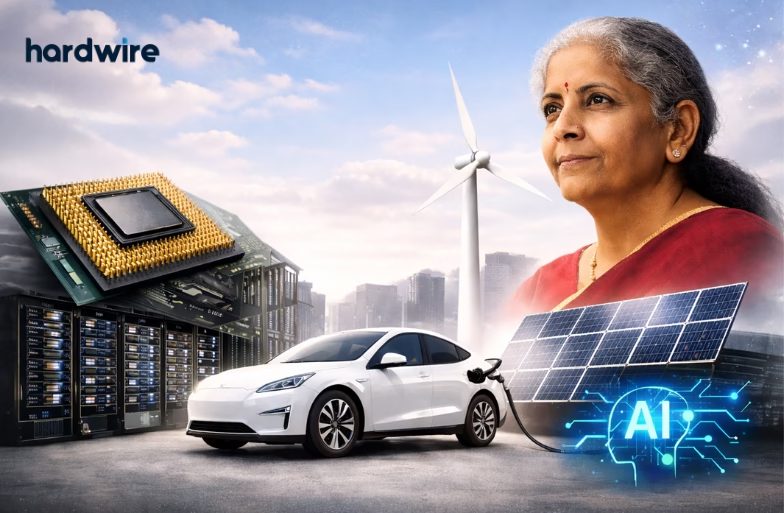
Finance Minister Nirmala Sitharaman presented the Union Budget 2026 in Parliament, calling it “producer-centric.” This year’s budget put a clear spotlight on technology and innovation, with new plans and funding for semiconductors, artificial intelligence and data centres. In this article, we have rounded up all the key tech-related announcements from the budget. Take a look!
Semiconductor Mission 2.0 to Strengthen Hardware Manufacturing
The government first launched the India Semiconductor Mission (ISM 1.0) to kickstart domestic chip design and manufacturing. This programme helped set up semiconductor fabrication units, develop local supply chains and reduce India’s reliance on imports. Building on this foundation, ISM 2.0 has been introduced in Budget 2026. This marks a bigger push to expand the complete semiconductor value chain from raw materials and design to full-scale production.
To support this expansion, the Electronics Components Manufacturing Scheme received a Rs 40,000 crore allocation. The goal is to attract private investment and make India a key player in the global semiconductor industry while boosting local innovation and job creation.
AI and Digital Tools
Artificial Intelligence also featured strongly in the budget with the launch of Bharat-VISTAAR. It is a multilingual AI platform for farmers. It will provide real-time agricultural advice in regional languages. This would help improve decision-making at the grassroots level.
A High-Powered Committee on Emerging Technologies was also proposed. It will study how AI and other new-age technologies impact jobs and skills. This step reflects the government’s plan to link education, technology and employment in a single framework.
Boost for EV and Clean Energy
One major announcement was the extension of tax relief on machines used to make lithium-ion battery cells. This benefit also covers equipment used for Battery Energy Storage Systems (BESS). This move aims to strengthen India’s push towards electric mobility and local battery production.
In addition, the government extended duty waivers for materials like sodium antimonate, which is used in solar glass manufacturing. These steps are expected to lower costs for renewable energy producers and encourage domestic manufacturing of clean-tech components. Industry experts said that this move supports India’s goal of becoming a self-reliant energy economy.
Data Centres, Cloud Incentives and IT Support
Budget 2026 announced a tax holiday till 2047 for data centre investments and cloud service providers operating from India. In simple terms, a tax holiday means companies do not have to pay income tax on profits earned from these operations for a set period. This encourages both domestic and foreign firms to invest in building cloud infrastructure and AI-enabled data centres in India.
In addition, the government raised the safe-harbour turnover limit for IT companies. This provides simplified tax rules and a fixed tax rate for eligible IT firms, reducing compliance burden and uncertainty. Together, these measures are aimed at attracting more tech investment, supporting data localisation, and strengthening India’s digital economy.
Digital Skills and Creative Tech Training
To prepare the next generation for digital jobs, the government has proposed Animation, Visual Effects, Gaming and Comics (AVGC) labs in 15,000 schools and 500 colleges. These labs will teach students digital content creation and design tools.
The plan also includes support for a new National Institute of Design in eastern India. This would strengthen creative and technical education.
Strengthening India's Orange Economy !
The Union Budget 2026–27 proposes support for the Indian Institute of Creative Technologies (IICT), Mumbai, to set up AVGC Content Creator Labs in 15,000 secondary schools and 500 colleges.
— FM @nsitharaman #ViksitBharatBudget… pic.twitter.com/28lvE5WyPC
— Ministry of Information and Broadcasting (@MIB_India) February 1, 2026
Conclusion
Budget 2026 clearly placed technology at the heart of India’s economic strategy. From clean energy and semiconductors to AI and cloud infrastructure, each measure supports the country’s move toward self-reliance and global competitiveness.
By keeping producers, innovators and youth at the centre, the budget aims to make India a stronger force in global technology.