







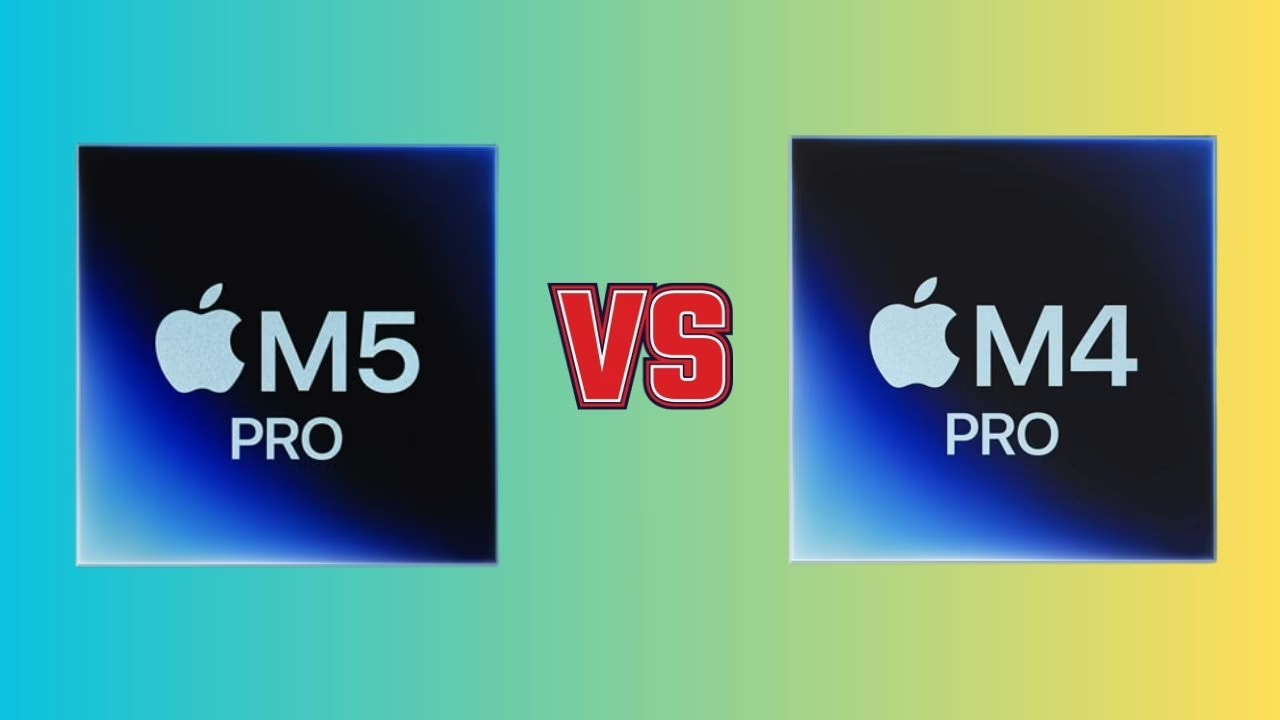
I’ve been tracking Apple Silicon since the beginning, and usually, the “Pro” and “Max” updates are predictable: just take the standard chip and add more “muscle.” But with today’s M5 Pro and M5 Max reveal, Apple just threw us a massive curveball.
We aren’t just looking at more cores; we’re looking at a fundamental shift in how Apple builds its processors. From a “chiplet” design to a brand-new tier of CPU cores, the M5 family is the biggest departure from the status quo we’ve seen yet.
The Big Shift: “Fusion Architecture”
For the first time, Apple is using a chiplet-based “Fusion Architecture” for its Pro and Max chips. In the past, they only did this for the ultra-expensive “Ultra” chips.
Instead of one solid piece of silicon, Apple is welding two distinct pieces together. One chiplet handles the heavy lifting (CPU and I/O), while the second focuses almost entirely on the GPU.
-
Why it matters: This modular approach allows Apple to scale graphics power much more efficiently. It’s a “work smarter, not harder” move that could solve the heat and yield issues that plague massive, single-piece chips.
Meet the “Super Core” (and the New Middle Child)
If you look at the spec sheet, you’ll notice the terminology has changed. Apple has introduced a third type of CPU core. We now have a three-tier hierarchy:
-
Super Cores: This is the new name for the top-tier “Performance” cores. They are built for raw, single-threaded speed.
-
Performance Cores: Wait, didn’t we just have those? Yes, but in the M5 Pro and Max, these are now a mid-tier core. They handle heavy multi-threaded workloads without sucking down as much power as a Super Core.
-
Efficiency Cores: These are still the battery-saving heroes we know, keeping your Mac cool during lighter tasks.
Technical Breakdown: M5 Pro vs. M5 Max
While the CPU/Neural Engine chiplet is the same across both, the graphics chiplet is where the Max earns its name.
M5 Pro Highlights:
-
Up to 6 Super Cores and 12 Performance Cores.
-
Up to 20 GPU cores.
-
307 GB/s memory bandwidth.
-
Supports up to four external displays.
M5 Max Highlights:
-
Same CPU layout as the Pro (6 Super / 12 Performance).
-
Up to 40 GPU cores (essentially double the Pro’s graphics power).
-
614 GB/s memory bandwidth—absolute overkill for most, but a dream for 3D rendering.
-
Supports up to five external displays.
The Verdict: Why It Matters
On paper, the M5 Max actually has fewer “big” cores than the M4 Max did. You might think that’s a downgrade, but Apple is betting that the increased efficiency of the new triple-tier core design and the massive jump in memory bandwidth will more than make up for it.
This feels like Apple moving away from a “more is better” strategy toward a specialized architecture that mimics how high-end PC enthusiasts build rigs—separating the brains from the brawn.
Stay tuned: We’ll be putting these through their paces the second they hit our lab to see if the “Super Cores” actually live up to the hype.


