


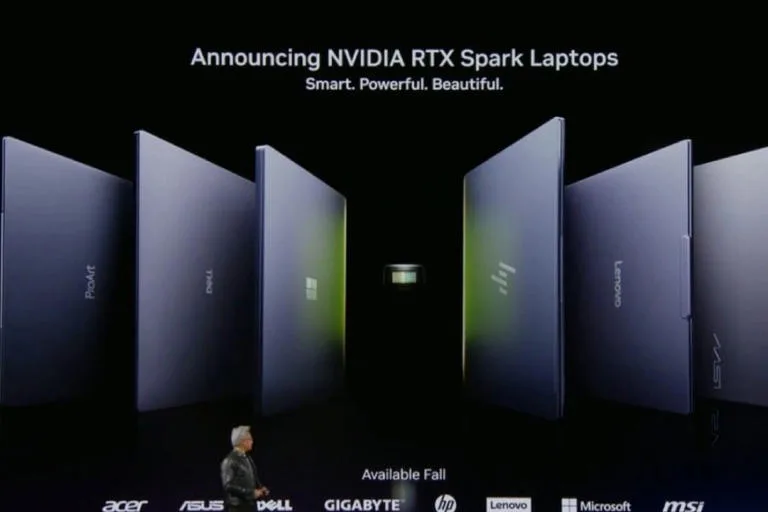
I’ve been tracking the AI hardware race for years, but what just happened at Computex in Taipei is a genuine shift in the landscape. Nvidia just kicked off the show by unveiling a brand-new PC processor called the RTX Spark.
This isn’t just another incremental upgrade. Nvidia is calling it a “superchip,” and they’ve already lined up a massive alliance of tech giants—including ASUS, Dell, HP, Lenovo, Microsoft, and MSI—to launch PCs powered by it this fall.
Here is exactly what this means for you, and why the traditional PC experience might be about to disappear.
The Tech Specs: A Local AI Powerhouse
Nvidia isn’t playing around with the hardware here. They are packing serious muscle into these machines to ensure you don’t have to rely on the cloud to run heavy AI tasks.
-
Performance: A staggering 1-petaflop of computing power.
-
Security: Dedicated, Microsoft-co-developed secure sandboxes to run digital agents safely.
-
Ecosystem: Full optimization for Nvidia’s CUDA software, heavy-duty RAM, and top-tier GPUs.
-
Software Support: Over 100 Windows software makers are already onboard, including Adobe, Blender, Riot Games, and Xbox.
The AI Vision: Goodbye, Pointing and Clicking
Why It Matters
Here’s the thing—this isn’t just about raw speed. Jensen Huang wants to kill the traditional desktop experience entirely. No more opening three different apps just to get one task done. You talk to the PC, and it handles the workflow. It uses built-in AI agents like Hermes to actually anticipate what you need. To be honest, if this works, it changes everything. Your PC goes from a tool you control to a partner that actually helps you get stuff done.
By utilizing local large language models and dedicated AI agents like OpenClaw or Hermes Agent, these machines aim to act as proactive assistants rather than passive tools.
Gaming & Content Creation: A Massive Leap
Why It Matters
For creators and gamers, this chip promises faster AI rendering, superior image quality, and day-one support for AI features in more than 1,000 games and apps.
Nvidia is positioning this as the ultimate upgrade for their core audience. If you’re rendering complex 3D environments in Blender or looking for frame-rate optimizations in next-gen titles, the local processing power means less latency and zero reliance on an internet connection to get the job done.
The Reality Check: Can Nvidia Pull Off a CPU?
Look, if you’ve been around the tech block for a while, you probably remember Nvidia’s last attempt at ARM-based Windows laptops back in 2013. Long story short, it was an absolute disaster. It ended up costing Microsoft a cool $900 million write-down on the ill-fated Surface RT.
But honestly? Things are totally different this time. Nvidia is on an absolute tear right now, and they’re eyeing a massive $200 billion market for these AI chips. Microsoft is so incredibly confident in this new hardware that they’re naming their next flagship the Surface Laptop Ultra. They’re calling it the most powerful Surface ever built, and frankly, I’re inclined to believe them. This isn’t just a minor refresh—it’s a whole different animal.
Here’s the real kicker: we still don’t know what these things will cost. Right now, they look a lot like consumer-friendly spin-offs of Nvidia’s $4,800 DGX Spark developer kit. That is not cheap. Will Nvidia actually try to compete with affordable setups like the Mac Mini—which everyone is using for local AI right now—or are we looking at a luxury item for rich tech nerds? Honestly, I’m betting on the latter.
If Nvidia has truly cracked the code on making local AI agents safe, fast, and accessible, the way we use computers is about to change forever.
I’ll be following the pricing announcements and hands-on benchmarks closely as we approach the fall launch window. Make sure to keep your eyes on this space—you won’t want to miss how these machines perform in the real world.

