


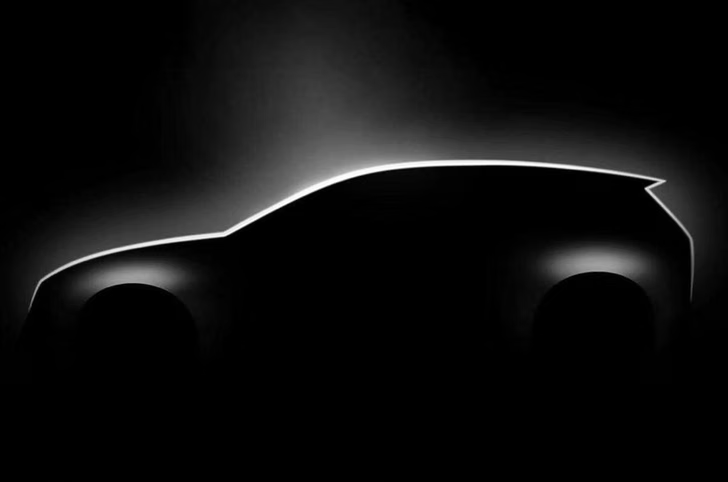
I’ve been tracking the whispers around the Volkswagen Golf EV for a while now, and if you were hoping to plug one in by 2028, I have some news that might sting a bit. Volkswagen CEO Thomas Schäfer just confirmed that we won’t see the electric version of this iconic hatchback until the very end of the decade.
It’s a bold move to delay such a heavy hitter, especially after we caught that teaser image just a few months ago. Here is the breakdown of what’s happening behind the scenes and why VW is hitting the brakes.
The New Architecture: SSP
The Golf EV isn’t just getting a battery swap; it’s waiting for the Scalable Systems Platform (SSP). This is the “holy grail” architecture for the VW Group, designed to finally make EVs as affordable to produce as gas cars.
-
800V Fast Charging: Expect lightning-fast pit stops.
-
Rivian Tech: Thanks to a recent joint venture, the software architecture is being co-developed with the American EV-maker.
-
Battery Tech: Next-gen cells aimed at squeezing out every mile of range.
Why the Delay?
Schäfer is being incredibly transparent here: Scale and Competition. The rise of Chinese EV brands has completely flipped the script on pricing. VW is currently “redoing the math” on material costs and investments to ensure they can actually turn a profit. They aren’t just building a car; they are fighting for margin parity. If they can’t make it as profitable as a petrol Golf, they aren’t ready to ship it.
The “Premium First” Strategy
Don’t expect VW to be the guinea pig for the new SSP platform. The rollout is following a “top-down” approach:
-
Audi & Porsche: These premium brands will debut the first SSP vehicles around 2028.
-
Volkswagen: The core brand (and the Golf) will follow once the tech is proven and the costs are lowered.
Filling the Gap: ID Models
I noticed a strategic shift in how they’re managing their current lineup. By pushing the Golf back, VW is giving more “breathing room” to their existing electric family.
-
ID.3 Neo & ID.Polo: These will be the primary focus for the next few years.
-
ID.Cross: Likely hitting the streets by the end of 2026.
Why it Matters
For you, the driver, this delay is a double-edged sword. On one hand, waiting until 2029 or 2030 feels like an eternity in the tech world. On the other hand, a “rushed” Golf on an old platform would likely be overpriced and under-specced. By waiting for the SSP architecture, VW is betting that the eventual Electric Golf will be the definitive “people’s car” for the 2030s—cheaper, faster-charging, and smarter.
Keep an eye on Audi’s 2028 launches; those will be our first real look at the DNA that will eventually make its way into the Golf. Are you willing to wait for the “perfect” electric Golf, or is the delay a dealbreaker?

